
Introduction
When buying cosmetic packaging, most attention goes to the bottle or jar. But the pump or dropper is what customers touch every day. It controls how the product is dispensed, how easy it is to use, and whether the packaging leaks. Choosing the wrong pump or dropper can lead to messy application, product waste, and unhappy customers.
This guide explains the main types of pumps and droppers, how to match them to your formula, and what to check before placing a bulk order.
Why Pump and Dropper Selection Matters
The dispensing component affects:
- User experience: A smooth pump or precise dropper feels premium.
- Product protection: Airless pumps and sealed droppers prevent oxidation and contamination.
- Dosage accuracy: Different products need different output rates.
- Leak prevention: A poor fit causes leaks during shipping and use.
- Brand image: A cheap pump can make an expensive formula feel low quality.
For B2B buyers, the pump or dropper is not an accessory. It is a critical part of the packaging system.
Types of Cosmetic Pumps
1. Lotion Pump
The most common pump for lotions, creams, and cleansers. It dispenses a fixed amount per press.
- Output rates: 0.5ml to 2.0ml per stroke.
- Materials: PP, PE, and sometimes metal springs.
- Closure sizes: 18/410, 20/410, 24/410, 28/410, etc.
Lotion pumps are cost-effective and widely available. They work well for water-based and oil-based formulas.
2. Airless Pump
Airless pumps use a vacuum system to dispense the product without letting air in. This protects active ingredients from oxidation.
- Output rates: 0.1ml to 0.5ml per stroke.
- Best for: Serums, anti-aging creams, vitamin C formulas.
- Advantages: Less waste, longer shelf life, hygienic.
- Disadvantages: Higher cost, more complex assembly.
Airless pumps are popular for premium skincare.
3. Spray Pump
Spray pumps dispense a fine mist. They are used for toners, facial mists, and setting sprays.
- Output rates: 0.05ml to 0.2ml per spray.
- Materials: PP, PE, and metal springs.
- Spray patterns: Fine mist, medium mist, or stream.
Spray pumps require compatibility testing with the formula to ensure a consistent spray.
4. Foam Pump
Foam pumps mix air with the liquid to create foam. They are used for cleansers, shaving foam, and hair products.
- Output rates: 0.4ml to 1.5ml per stroke.
- Best for: Watery formulas with low viscosity.
Foam pumps need a specific formula consistency to work properly.
Types of Cosmetic Droppers
1. Glass Dropper
A glass pipette with a rubber bulb. Common for essential oils, serums, and oils.
- Sizes: 5ml to 100ml.
- Pipette types: Straight, graduated, or curved.
- Bulb materials: Natural rubber, nitrile, or silicone.
Glass droppers offer a premium look and precise dosing. They are not ideal for thick formulas.
2. Plastic Dropper
A plastic pipette with a squeeze bulb. Lighter and cheaper than glass.
- Best for: Travel sizes and mass-market products.
- Disadvantages: Less premium feel, may discolor over time.
3. Press-Down Dropper
A dropper with a button or pump mechanism. It dispenses a precise drop with each press.
- Best for: High-end serums and precise dosing.
- Advantages: Hygienic, easy to use, no contamination.
- Disadvantages: Higher cost, more components.
4. Dropper Bottle with Tamper-Evident Cap
A dropper integrated with a tamper-evident closure. Common for essential oils and CBD products.
- Provides security and prevents tampering.
- Available in child-resistant versions.
Key Factors in Pump and Dropper Selection
1. Formula Compatibility
- Viscosity: Thin liquids need different pumps than thick creams.
- Ingredients: Alcohol, essential oils, and acids can degrade certain plastics or rubbers.
- Preservatives: Some preservatives interact with rubber bulbs.
Always test the pump or dropper with your actual formula.
2. Output Rate and Dosage
- Lotion pumps: 0.5ml–2.0ml per stroke.
- Airless pumps: 0.1ml–0.5ml per stroke.
- Droppers: 0.02ml–0.1ml per drop.
Choose an output rate that matches the recommended dosage for your product.
3. Closure Size and Neck Finish
Pumps and droppers must match the bottle neck. Common sizes include:
- 18/410
- 20/410
- 24/410
- 28/410
Always confirm the neck finish with your bottle supplier.
4. Material Selection
- PP: Good chemical resistance, common for pumps.
- PE: Softer, used for some dropper bulbs.
- Glass: Inert, premium, used for dropper pipettes.
- Rubber/Silicone: Used for bulbs and gaskets. Must be compatible with the formula.
5. Sealing and Leak Prevention
- Check the gasket and liner.
- Test the pump or dropper for leaks after filling.
- Consider secondary seals for shipping.
6. Aesthetic and Brand Fit
- Color: Custom colors available.
- Finish: Glossy, matte, metallic, or soft-touch.
- Shape: Round, square, or custom.
- Printing: Logo, branding, and dosage markings.
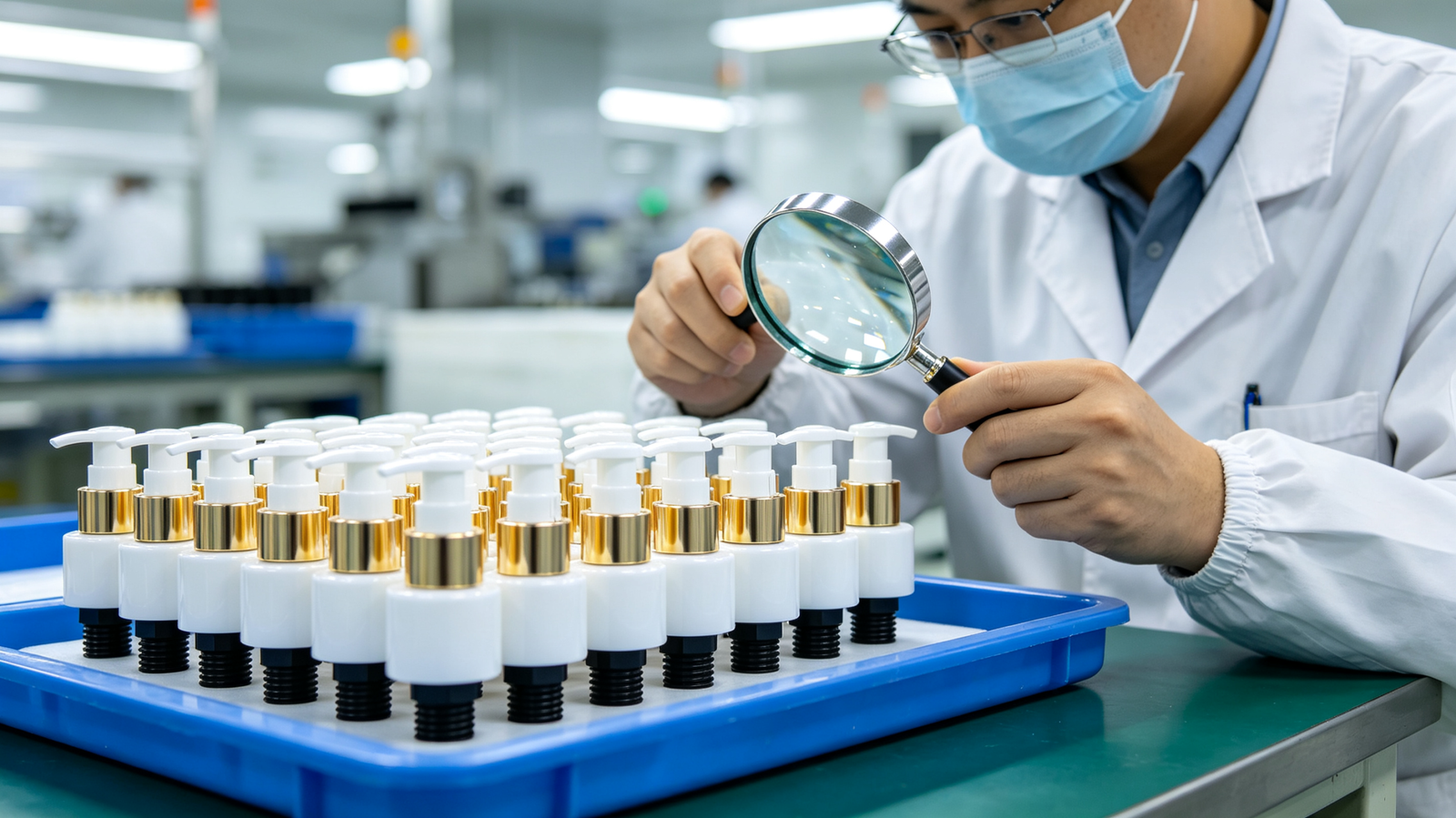
Quality Control Checklist
Before bulk production, check:
- Output rate consistency
- Leak-proof performance
- Smooth operation
- Material compatibility
- Color and finish accuracy
- Assembly strength
- Tamper-evident function (if applicable)
Ask for samples and test them with your actual formula.
Common Mistakes in Pump and Dropper Selection
- Choosing by price only: Cheap components often fail.
- Skipping compatibility testing: The pump may work with water but fail with your formula.
- Ignoring neck size: A mismatch causes leaks.
- Not testing output rate: Too much or too little product per press.
- Overlooking shipping conditions: Pumps may leak during air transport due to pressure changes.
How Bingoo International Supports Pump and Dropper Selection
Bingoo International is a professional packaging supplier based in China. We offer a wide range of cosmetic pumps and droppers, including lotion pumps, airless pumps, spray pumps, foam pumps, glass droppers, plastic droppers, and press-down droppers.
We help B2B buyers select the right components for their formula, bottle, and brand. We can provide samples, compatibility guidance, and quality control support. Whether you need stock components or custom designs, we can help you find the right solution.
Conclusion
Pumps and droppers are small components with a big impact. Choose the right type, material, and output rate for your product. Test with your actual formula and work with a supplier who understands compatibility and quality. If you need help selecting pumps or droppers for your cosmetic packaging, contact us today.
FAQ
Q: What is the difference between a lotion pump and an airless pump?
A: A lotion pump dispenses product by suction and lets air in. An airless pump uses a vacuum and keeps air out, protecting sensitive ingredients.
Q: How do I choose the right dropper for my serum?
A: Consider viscosity, dosage, and compatibility. Glass droppers are premium and precise. Press-down droppers are hygienic and easy to use.
Q: Can I use the same pump for different formulas?
A: Not always. Viscosity and ingredients affect pump performance. Always test with each formula.
Q: Does Bingoo International provide samples?
A: Yes, we provide samples for quality and compatibility testing. Contact us for details.